


How Long Do Garage Door Springs Last in Arizona?
If your garage door is starting to sound a little rougher than it used to, or you're just trying to plan ahead before something breaks, you've landed on the right question. Garage door springs don't last forever anywhere — but in Arizona, they last noticeably less time than almost anywhere else in the country. Here's the direct answer, then everything behind it.
Most garage door torsion springs last 3 to 5 years in Arizona — well short of the 7 to 10 years (10,000–20,000 cycles) torsion springs typically last in milder climates.
The gap comes down to heat. Sustained temperatures above 110°F accelerate metal fatigue in torsion springs, and the same heat dries out lubrication faster, adding friction-related wear on top of the normal cycle count. A spring rated for 10,000 cycles in ideal conditions may reach that fatigue point in noticeably fewer real-world years once you factor in an Arizona summer.
Why Arizona Heat Shortens Garage Door Spring Life
Garage door springs are rated by manufacturers for a specific number of open-close cycles — most standard residential torsion springs are rated somewhere between 10,000 and 20,000 cycles, depending on wire gauge and coil design, following testing standards set by the Door & Access Systems Manufacturers Association (DASMA). On paper, that sounds like a long time. A household opening the garage door 4 times a day uses roughly 1,460 cycles per year, which would put a 10,000-cycle spring at a 7-year lifespan under ideal conditions.
The problem is that "ideal conditions" assumes a moderate climate. In the Valley, uninsulated garages routinely hit 130°F–140°F in direct summer sun, and that heat does two things to a torsion spring at once:
Thermal fatigue accelerates cycle wear
Steel expands and contracts with heat. A spring that's constantly cycling through extreme daily temperature swings — cool mornings, scorching afternoons — experiences more microscopic stress on the metal with every cycle than the same spring would in a stable 70°F environment. This effectively "uses up" cycle life faster than the odometer-style cycle count alone would suggest.
Dried lubrication adds friction-based wear
Every torsion spring is manufactured with an internal lubricant coating that reduces coil-on-coil friction as the spring winds and unwinds. In Arizona heat, that factory lubricant — and any lubricant applied during a service visit — breaks down and evaporates faster than in milder climates. Once the coating thins out, the spring's coils rub against each other and against the center bearing plate on every cycle, adding wear that isn't part of the manufacturer's original cycle rating at all.
Combine both effects, and a spring that "should" last 8–10 years by the numbers often reaches end-of-life in just 3–5 real-world years here — which is exactly what we see on service calls across Scottsdale, Phoenix, and the rest of the Valley.

6 Warning Signs Your Springs Are Wearing Out — Before They Snap
Torsion springs rarely give much warning before they fail completely, but they aren't always silent either. If you catch these signs early, you can schedule a planned replacement instead of an emergency one:
Spring Failure Warning Signs
- The spring looks like it's sagging, warping, or "snaking" along its length instead of sitting in a tight, even coil — this is a visible sign of metal fatigue and often shows up before a full break.
- The door feels heavier than it used to when you lift it manually with the opener disconnected — a properly tensioned door should lift with minimal effort.
- The opener strains, slows down, or reverses unexpectedly as it compensates for a spring that's no longer carrying its share of the door's weight.
- You notice a visible gap in the spring coil — a small separation between coils is often one of the first signs of a spring about to fail.
- The door looks uneven or crooked when opening or closing, especially on two-spring systems where one side has failed while the other hasn't yet.
- You hear a loud bang from the garage — even if the door still opens afterward. That sound is very often the spring itself, and it means the failure has already happened.

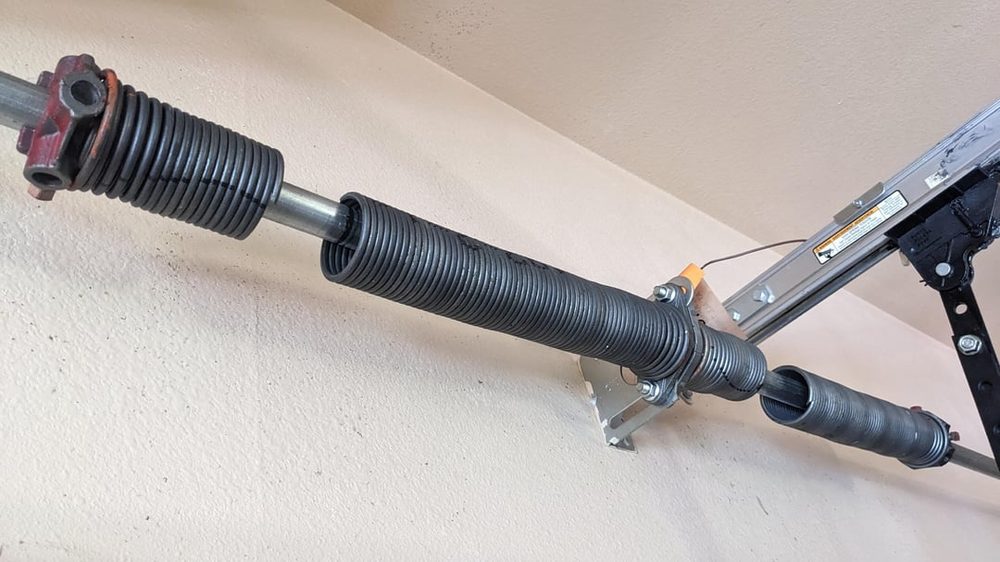
This sagging or snaking appearance happens as the coils lose their uniform spacing under repeated heat cycling — the spring is still technically holding tension, but unevenly, which is exactly the kind of degraded performance that shows up as a heavier door or a struggling opener. It's one of the more reliable visual warning signs you can check for yourself without touching the spring.
A fully wound torsion spring stores enough tension to cause serious injury or death if it releases suddenly. This is one of the few home repairs we'd tell you outright not to attempt — call a licensed technician with the correct winding bars and tools.
Why We Always Replace Both Springs, Not Just the Broken One
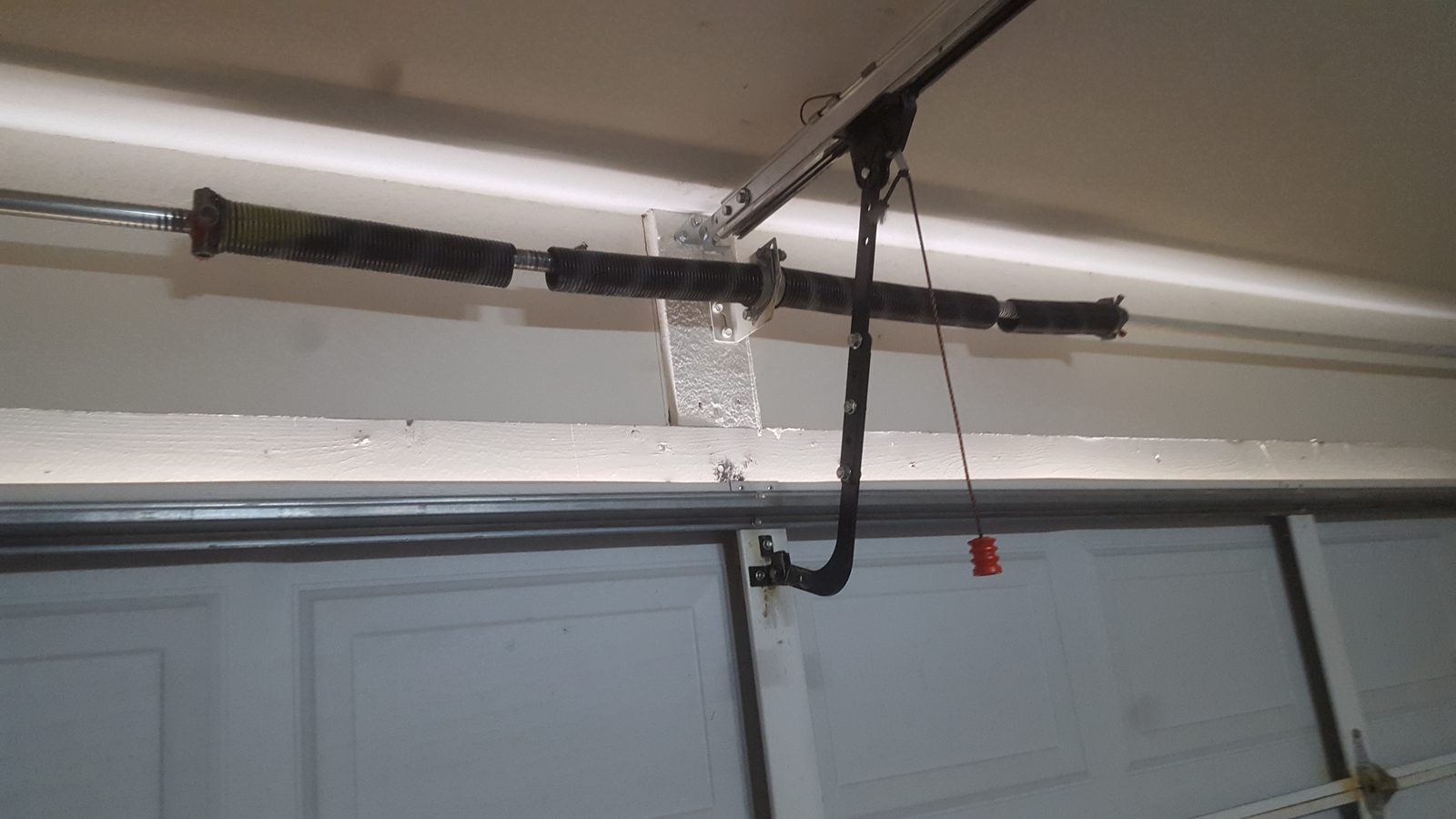
On a two-spring door, it's tempting to replace only the spring that actually failed and leave the other one alone — especially if it looks fine. We don't do it that way, and neither should any licensed technician, for a simple reason: both springs were installed at the same time and have gone through the same number of cycles under the same heat exposure. If one has reached the end of its fatigue life, the other is close behind it, whether or not it's shown visible signs yet.
Replacing only the failed spring also creates a mismatched pair — one old, one new — that puts uneven tension on the door and accelerates wear on the new spring as it compensates for the older one's declining performance. It's a short-term savings that costs more within a year or two.
How Much Does Garage Door Spring Replacement Cost in Arizona?
Spring replacement pricing depends on spring size, the size and weight of your door, and whether both springs need replacement — which, per above, is almost always the case. Calling before a full failure — when you've noticed one of the warning signs above rather than after the door won't open at all — gives you more flexibility on timing and avoids any after-hours or emergency premium.
We also don't take a one-size-fits-all approach to spring selection. Depending on your door's weight, size, and how often it's used, we install springs rated anywhere from 10,000 to 50,000 cycles — matching the spring to the actual demands of your door rather than defaulting to a single standard option for every job. We'll walk you through the options and let you choose the cycle rating that fits your budget and how long you want the spring to last, rather than picking for you.
We provide a clear quote before any work begins, with no hidden fees. Call Charlie at (480) 548-0807 for current pricing specific to your door and spring size.

Can You Extend the Life of Your Garage Door Springs?
You can't stop Arizona heat, but a few habits meaningfully slow down spring wear:
- Keep the spring properly lubricated. A light coat of white lithium grease on the spring coils during routine maintenance reduces the coil-on-coil friction that adds wear beyond normal cycle counts.
- Don't overload the door with weight. Adding heavy insulation kits or accessories to an existing door without re-balancing the spring tension forces the spring to work harder on every cycle.
- Address opener force settings. An opener with force settings set too high can mask a spring that's losing tension — which hides the problem while still putting more strain on the system.
- Get an annual balance check. A simple manual balance test — lifting the disconnected door to waist height and seeing whether it holds position — takes 60 seconds and tells you whether the spring is still doing its job properly.
Garage Door Spring Replacement Across the Valley
We replace garage door springs throughout the greater Phoenix metro, and every community sees slightly different failure patterns based on sun exposure, home age, and door type:
Scottsdale
Scottsdale's concentration of heavier wood-look and insulated steel doors means springs here carry more load than the Valley average, and we see a high volume of torsion spring replacements every summer — particularly in north Scottsdale on wide 3-car door panels. Schedule Scottsdale spring replacement →
Phoenix
Phoenix's west-facing corridors see the most intense direct afternoon heat exposure in the Valley, which shows up in our service data as some of the earliest spring failures we see anywhere — often 1–2 years before the same door style would fail in a shadier location. Schedule Phoenix spring replacement →
Paradise Valley
Paradise Valley's custom doors — full-view glass panels and heavy wood carriage house styles in particular — put meaningfully more strain on springs than a standard steel door. We size springs specifically for each door's actual weight rather than a generic replacement. Schedule Paradise Valley spring replacement →
Cave Creek & Carefree
Cave Creek and Carefree properties often see harder daily use on ranch-style garages and detached structures, and desert dust works its way into spring coils faster on unpaved or semi-rural properties, adding abrasive wear alongside the heat. Schedule Cave Creek spring replacement →
Fountain Hills
Fountain Hills' hillside homes see more direct, unobstructed sun exposure on south- and west-facing garages than flatland communities, which tracks with the earlier-than-average spring wear we see on service calls in the area. Schedule Fountain Hills spring replacement →
Ahwatukee
Ahwatukee sits in one of the hottest urban heat pockets in the Phoenix metro, with afternoon sun reflecting off South Mountain adding extra ambient heat to south-facing garages. Springs here tend to show fatigue noticeably earlier than identical springs on north-facing garages elsewhere in the Valley. Schedule Ahwatukee spring replacement →
Arcadia & Tempe
Across Arcadia's established tree-lined lots and Tempe's mix of long-established and newer construction, the pattern holds consistently: heat exposure and door weight are the two biggest predictors of how soon a spring needs replacing, regardless of neighborhood. Arcadia · Tempe

Not Sure How Old Your Springs Are?
Free service call with repair. Call Charlie at (480) 548-0807 for a spring inspection before a failure turns into an emergency call. We serve Scottsdale, Phoenix, Paradise Valley, Cave Creek, Carefree, Fountain Hills, Ahwatukee, Arcadia, Anthem, Tempe, and the surrounding Valley.
Call (480) 548-0807Frequently Asked Questions: Garage Door Spring Lifespan in Arizona
How long do garage door springs last in Arizona specifically?
Most torsion springs last 3 to 5 years in Arizona, compared to 7 to 10 years in milder climates. The difference comes from sustained extreme heat, which accelerates both metal fatigue and lubricant breakdown.
Is it normal for a garage door spring to just snap without warning?
Yes — sudden failure with a loud bang is actually the most common way torsion springs fail, since metal fatigue builds invisibly until the spring reaches its breaking point. Visible warning signs like coil gaps or a heavier-feeling door do occur, but they aren't guaranteed before failure.
Do I need to replace both springs if only one breaks?
Yes. Both springs go through the same number of cycles under the same conditions, so if one has failed, the other is close behind. Replacing both prevents uneven tension and premature failure of the "good" spring shortly after.
Can a broken garage door spring damage my opener?
Yes. Once a spring breaks, the opener has to lift the door's full weight instead of the small fraction it's designed for. Continuing to use the opener with a broken spring can burn out the motor, strip gears, and damage the drive system — on top of the spring repair itself.
What does it mean if my garage door spring looks like it's sagging or "snaking"?
A spring that no longer sits in a tight, even coil — and instead looks like it's sagging, warping, or snaking along the shaft — is showing visible metal fatigue from repeated heat cycling. It's still holding some tension, but unevenly, and it's one of the more reliable signs a spring is nearing the end of its life before it breaks completely. If you notice this, it's worth scheduling a replacement rather than waiting for a full failure.


 (480) 548-0807