


By Frank Vargas · Security Door Gate & Fence · Scottsdale, AZ · July 2026
If I had to guess the first sentence out of a customer's mouth on 90% of our garage door service calls, it would be some version of "it's making this weird noise." A garage door noise in Arizona almost always tells us what's wrong before we even pull into the driveway — a grinding sound means something different than a popping sound, and a single loud bang means something completely different than a rhythmic rattle. After 35 years of listening to garage doors across the Valley, I can usually diagnose the problem over the phone just from how the customer describes the sound.
This guide breaks down every common garage door noise, what's actually causing it, and — most importantly — which noises mean you should stop using the door immediately and which ones can wait for a scheduled appointment.
Why Arizona Garage Doors Get Noisier Than Doors Anywhere Else
Before we get into specific sounds, it's worth understanding why Valley garage doors tend to develop noise issues faster than doors in milder climates. Two things are working against you here.
First, heat evaporates lubricant. Standard grease and lubricant on rollers, hinges, and springs breaks down and dries out faster at 115°F than it would in a temperate climate, and a dry moving part is a noisy moving part. Second, our dry climate means dust, not moisture, is the enemy — fine desert dust works its way into roller bearings and track channels, and combined with dried-out lubricant, it turns smooth metal-on-metal contact into a grinding, gritty mess. On top of that, the extreme daily temperature swing common here — cool mornings into 110°F+ afternoons — causes metal components to expand and contract every single day, which loosens hardware over time in a way that doesn't happen as quickly in more stable climates.
The upshot: if you live in the Valley, your garage door needs lubrication and hardware checks roughly twice as often as a garage door in a mild coastal climate. Most of the noises below trace back to one of these two root causes. This is exactly why we build a twice-yearly lubrication and hardware inspection into every Scottsdale garage door maintenance visit rather than the once-a-year schedule that works fine in milder climates. (If you have an automatic gate too, the same heat-and-dust problem shows up there — we cover that separately in why Arizona summer is hardest on automatic gate operators.)
Garage Door Noise Guide: What Each Sound Means in Arizona
Grinding or Gritty Metal-on-Metal Sound

Roller maintenance in progress — dust-packed, dry bearings on worn rollers are the leading cause of the grinding noise homeowners report most often.
This is the most common noise complaint we get, and it's almost always one of two things: dry, dust-packed roller bearings, or a roller that's worn out and riding unevenly in the track. Steel rollers are the loudest offenders — they're durable but they transmit every bit of friction directly into a grinding sound. Nylon rollers with sealed bearings run significantly quieter and hold up better against Arizona dust, which is why we recommend them on almost every service call where we're replacing rollers.
If the grinding is coming from one specific spot on the track rather than following the door's full travel, that usually points to a bent track section rather than a roller problem — a repair that shouldn't wait, since a bent track can eventually let a roller jump out entirely.
Squeaking or Squealing

A dried-out, worn garage door hinge — the most common source of the squeal homeowners hear on every door cycle.
Squeaking is the classic dry-hinge sound. Every garage door has a series of hinges connecting the door panels, and each hinge pivots thousands of times a year. Without lubrication, metal hinge pins squeal against their hinge barrels. This is the single easiest noise to fix yourself — a silicone-based garage door lubricant (not WD-40, which attracts dust rather than repelling it) on every hinge pin and roller stem usually eliminates squeaking within one or two door cycles.
Loud Rattling While Opening or Closing
Rattling is almost always loose hardware — and in Arizona's heat-cycle climate, hardware works itself loose faster than you'd expect. Track brackets, hinge bolts, and the bolts holding the opener's motor unit to the ceiling all vibrate slightly with every cycle, and over hundreds of cycles a year, they back out. A full hardware check — tightening every bolt on the track brackets, hinges, and opener mounting — resolves the vast majority of rattling complaints.
If the rattling is specifically coming from the opener rail (the long arm connecting the motor to the door), that's often a loose chain or belt tension issue rather than a hardware problem, and it's worth having a technician adjust it rather than tightening things yourself — over-tightening a chain can cause premature opener wear.
A Single Loud Bang or Pop
This is the noise that should make you stop and not touch the garage door opener. A single loud bang, usually described as sounding like a gunshot, is the signature sound of a torsion spring breaking. The spring is under enormous tension — enough that when it fails, the sudden release of that tension makes a sound loud enough to hear from inside the house. If you hear this, do not attempt to open the door, manually or with the opener. Call for service. We've covered spring lifespan and replacement in detail in our guide to how long garage door springs last in Arizona.
Rhythmic Popping or Clicking During Travel
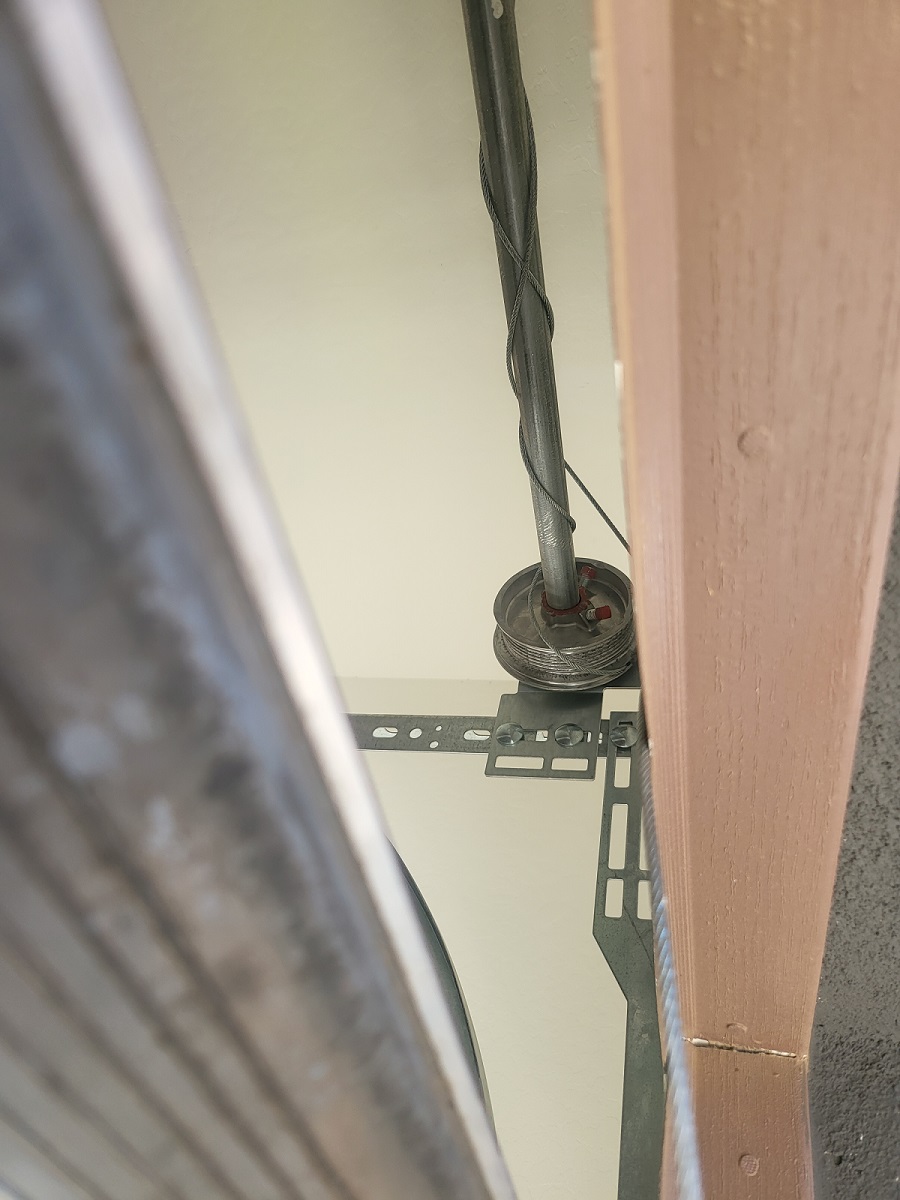
A cable riding incorrectly on the torsion bar — a common source of the repeated popping or clicking sound that happens at the same point in every door cycle.
Unlike the single bang of a spring failure, a repeated popping or clicking sound that happens at the same point in the door's travel every single cycle usually points to a damaged section of track, a worn roller catching on a specific spot, or in some cases a cable that's slightly frayed and catching on the drum as it winds. This is worth a diagnostic visit rather than DIY lubrication, since a fraying cable is a safety issue, not just a noise issue.
Humming With No Movement

Diagnosing an opener that hums but doesn't move the door — usually a worn drive gear or a heat-damaged capacitor inside the motor housing.
If you press the remote or wall button and the opener motor hums but the door doesn't move at all, that's an opener issue, not a door issue. Common causes include a burned-out drive gear inside the opener unit (a plastic gear that's designed to wear out before the motor does, to protect the motor from damage), a jammed chain or belt, or in rare cases a failed capacitor inside the motor housing — the same heat-related capacitor failure we see in gate operators during peak summer months.
Vibrating or Buzzing Sound From the Opener Unit
A steady buzz or vibration from the opener housing itself, separate from the door's movement, often points to a loose motor mount or a failing motor bearing. This tends to get progressively louder over weeks or months rather than appearing suddenly, so if you've noticed the opener getting steadily noisier, it's worth having it inspected before the motor fails completely — motor replacement is a bigger job than a mount tightening.
Which Noises Mean Stop Using the Door Right Now

A garage door that came off its track in Scottsdale — the kind of failure that's often preceded by days or weeks of warning noises that got ignored.
Most garage door noises are annoying but not dangerous. A few are not. Stop using the door immediately and call for service if you experience any of the following:
- A single loud bang or pop, followed by the door feeling heavy, uneven, or refusing to open — this is a broken spring
- Visible fraying, kinking, or unraveling on either lift cable
- A grinding or scraping sound that's gotten noticeably louder over the past day or two, especially if paired with the door moving unevenly on one side
- Any noise that coincides with the door sagging, tilting, or appearing crooked in its opening
None of these are noises to "keep an eye on." A garage door under spring tension that fails while someone is standing underneath it, or a door that jumps its track mid-cycle, can cause serious injury or property damage. The Door and Access Systems Manufacturers Association (DASMA) lists torsion spring servicing among the leading causes of garage door injuries nationwide for exactly this reason. When in doubt, stop using the door and call.
DIY Noise Fixes vs. When to Call a Technician
Safe to try yourself: Lubricating hinges, rollers, and the opener rail with a silicone-based garage door lubricant. Tightening visibly loose bolts on track brackets and hinges by hand with a wrench (do not use a power drill, which can over-tighten and strip the hardware). Wiping down photo-eye sensors if the door reverses unexpectedly — see our complete guide to how garage door sensors work if the reversing continues after cleaning. Door manufacturer Clopay's own noisy-door troubleshooting guide recommends this same lubricate-and-tighten approach as the first step before calling for service, which lines up with what we see in the field.
Always call a technician for: Anything involving the torsion spring or the cables — these parts are under high tension and are not a DIY repair under any circumstances. Track realignment. Opener motor or gear replacement. Any noise paired with the door moving unevenly, sagging, or binding.
Garage Door Noise FAQ
Is it normal for a garage door to make some noise?
Some operational sound is normal — motor hum during travel, a soft roll of the rollers in the track. What's not normal is grinding, squealing, rattling, banging, or any sound that's new, gotten louder recently, or accompanies uneven door movement.
How often should I lubricate my garage door in Arizona?
We recommend lubricating hinges, rollers, and the opener rail every three to four months in the Valley — roughly twice as often as manufacturers typically recommend for milder climates — because of how quickly Arizona heat dries out standard lubricants.
My garage door is loud but still works fine. Should I still get it looked at?
Yes, especially if the noise is new or worsening. A noisy door is almost always an early warning sign — worn rollers, drying hardware, loosening bolts — of a problem that's cheaper and easier to fix now than after it causes a bigger failure like a jumped track or a broken spring.
Can I fix a noisy garage door myself?
Lubrication and tightening visibly loose hardware by hand are reasonable DIY tasks. Anything involving the torsion spring, lift cables, or the door coming off track should always go to a licensed technician — these components are under enough tension to cause serious injury if handled incorrectly.
Is there a service call fee for a noise diagnosis?
Free service call with repair. Call Charlie at (480) 548-0807 to schedule.
Stop Guessing What That Noise Means
Free service call with repair. Call Charlie at (480) 548-0807 — we serve Scottsdale, Phoenix, Paradise Valley, Cave Creek, Carefree, Fountain Hills, Ahwatukee, Tempe, Arcadia, and Anthem. Same-day response available.
Frank Vargas — Owner, Security Door Gate & Fence
4th-generation Phoenix native and AFA Certified Gate Automation Designer with 35+ years servicing garage doors and gates across the greater Phoenix area. AZ ROC #325648, #325650, #314281.
Related service pages
- Garage Door Repair | Valley-Wide
- Phoenix Garage Door Repair | Same-Day Service
- Scottsdale Garage Door Maintenance | Preventative Care
- Garage Door Springs | Scottsdale
- Garage Door Opener Repair | Scottsdale


 (480) 548-0807