


By Frank Vargas · Security Door Gate & Fence · Scottsdale, AZ · July 2026
Automatic gates talk to you before they fail — the problem is most homeowners don't know how to listen. A grinding slide gate is telling you something completely different than a swing gate that clicks on every cycle, and a motor that hums without moving the gate is a different repair entirely from one that clunks and stops. After 35 years diagnosing gate problems across the Valley, I can usually tell what's wrong before I even open the operator housing — just from the sound the customer describes on the phone.
This guide breaks down every common automatic gate noise, what's actually causing it in Arizona's heat and dust, and which sounds mean you should stop using the gate until it's inspected.
Why Arizona Heat Makes Automatic Gates Louder Than Anywhere Else
Gate operators work harder in the Valley than almost anywhere else in the country, for two reasons that compound each other. First, sustained summer heat — operator housings sitting in direct sun regularly reach internal temperatures well above 140°F — dries out chain and hinge lubricant far faster than in a mild climate, and dry moving metal is loud moving metal. Second, our dry climate means fine desert dust works its way into every gap in a gate system: wheel bearings, chain links, hinge pins, and track channels. Combine dried-out lubricant with dust intrusion and you get exactly the grinding, squealing, and clicking sounds covered below.
The same heat-and-dust pattern shows up on garage doors too — if your garage door has started making noise as well, we cover that separately in our full guide to garage door noises in Arizona.
Automatic Gate Noise Guide: What Each Sound Means
Grinding or Gritty Sound on Slide Gates

Slide gate wheels running in a dust-packed or dry track are the most common source of grinding noise we diagnose across the Valley.
Slide gates ride on wheels moving along a track, and that track is exposed to every bit of blowing desert dust your property sees. Combine that dust with dried-out wheel bearing lubricant, and you get a gritty, grinding sound on every open and close cycle. If the grinding is localized to one spot in the gate's travel rather than the whole cycle, that usually points to a section of damaged or debris-packed track rather than a wheel problem — worth a look before the wheel jumps the track entirely.
Clicking or Chain Slap on Chain-Drive Gates

A loose or worn chain on a chain-drive gate operator produces a rhythmic clicking or slapping sound as it runs — usually a simple tension adjustment.
Chain-drive gate operators — common on both slide and swing gates — use a drive chain similar in concept to a bicycle chain. As that chain stretches slightly over years of heat cycling, it starts slapping against its housing or guide with a rhythmic click on every cycle. This is usually a straightforward chain tension adjustment rather than a full replacement, but a chain that's skipping teeth on the sprocket needs attention quickly — a chain that jumps off the sprocket mid-cycle can let the gate move unpredictably.
Motor Humming With No Gate Movement

An operator that hums but doesn't move the gate is almost always a motor or capacitor issue rather than a gate problem.
If the operator hums audibly when triggered but the gate doesn't move at all, that's a motor-side issue, not a gate-side one. The most common cause in Arizona summers is a heat-damaged run capacitor — the small component that gives the motor its initial torque to start moving. We replace far more gate operator capacitors in July and August than any other month, for the same reason we replace more garage door opener capacitors then too: sustained heat above the component's rating shortens its life dramatically.
Squealing or Screeching on Swing Gate Hinges

Dry hinge pins on heavy iron swing gates are the most common source of the squeal homeowners hear on every open and close cycle.
Swing gates pivot on hinges the same way a garage door pivots on its panel hinges, and the heavier the gate — custom iron and wood-and-iron gates especially — the more load those hinge pins carry. Without regular lubrication, dry hinge pins squeal loudly under that load. This is the easiest gate noise to fix yourself: a silicone-based lubricant on every hinge pin, applied every few months in our climate rather than once a year, usually resolves it within a cycle or two.
Buzzing or Erratic Behavior From the Control Box
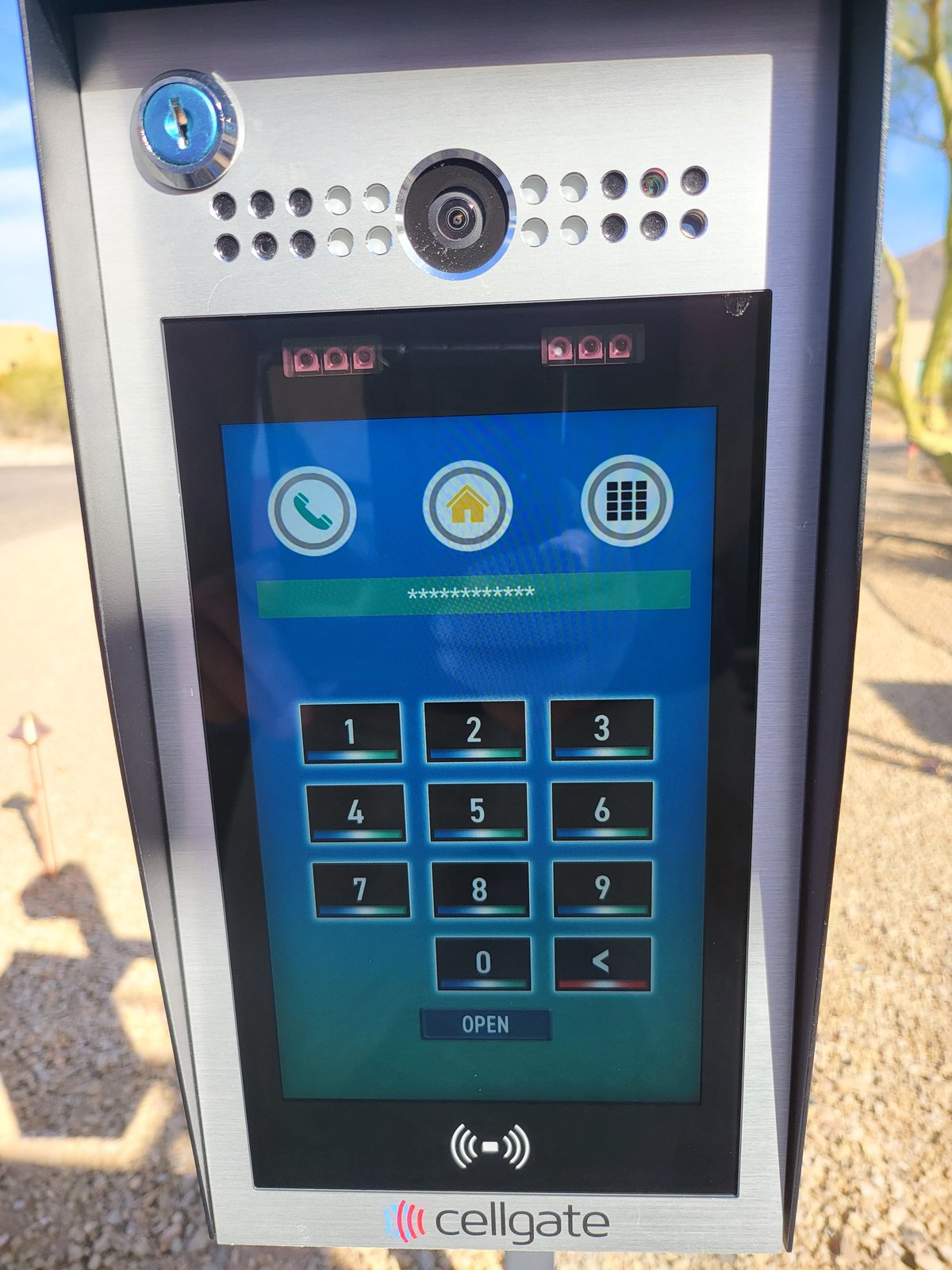
A buzzing sound or erratic behavior from the control box points to circuit board or transformer stress, not a mechanical gate problem.
A buzzing sound coming from the control box itself — separate from the motor or gate movement — usually points to a stressed transformer or a circuit board nearing failure. This is also where wasps and dust intrusion show up most in summer, since control boxes have ventilation gaps just like garage door opener housings. If your gate has started behaving erratically (opening partway, not responding to remotes, throwing intermittent errors) alongside a buzzing sound, the control box is the place to start looking.
Clunking or Banging During Travel
A single clunk or bang at the same point in the gate's travel every cycle often points to a loose operator arm connection on swing gates, or a chain/belt that's skipping a tooth at the same rotation point on drive systems. Unlike the rhythmic clicking of a slightly loose chain, a hard clunk at a consistent point is worth a diagnostic visit rather than DIY tightening, since it can indicate a connection that's close to failing rather than just needing an adjustment.
Which Gate Noises Mean Stop Using It Immediately

Automatic gates are powerful machinery under real force — the kind of failure that follows ignored warning noises can be serious, not just inconvenient.
Most gate noises are annoying but not urgent. A few mean you should stop using the automatic function and switch to manual operation (or avoid the gate entirely) until a technician looks at it:
- Any grinding or scraping that's gotten noticeably louder over a day or two, especially paired with the gate moving unevenly or slower than normal
- A hard clunk or bang at a consistent point in travel, which can mean a connection point is close to failing
- Any noise that coincides with the gate binding, dragging, or appearing to strain against something
- Scratching, rustling, or rattling sounds from inside the operator housing itself, which can mean active wildlife nesting — we cover this in detail in why Arizona summer is hardest on automatic gate operators
Automated gate operators are manufactured and tested to UL 325, the nationally recognized safety standard for vehicular gate operators, precisely because a gate under motor force can cause serious injury if something fails while it's in motion. If a noise is paired with any of the warning signs above, don't wait for a full failure — call for an inspection.
Common Summer Gate Repairs Beyond Noise

Backup batteries degrade faster in sustained Arizona heat — a common summer failure point that has nothing to do with noise.
Noise is usually the first symptom, but a few other issues show up specifically during Arizona summers that aren't always noise-related:
- Sluggish movement on hydraulic operators. HySecurity, FAAC, and similar hydraulic operators can run noticeably slower in extreme heat as standard hydraulic fluid thins out — a high-temperature fluid grade usually resolves it.
- Remote and keypad range dropping. Heat affects the RF components in remotes and receivers, and range that's fine in spring can noticeably shrink by August.
- Photo-eye sensor false triggers. Dust buildup on sensor lenses after a haboob can cause a gate to refuse to close even with a clear path — a 30-second wipe-down of both lenses is the first thing to check.
- Battery backup failure. Backup batteries degrade faster in sustained heat, and a gate that won't operate during a monsoon power outage is often a battery that was already failing before the storm.
DIY Fixes vs. When to Call a Technician
Safe to try yourself: Lubricating hinge pins with a silicone-based lubricant. Wiping down photo-eye sensor lenses. Checking for obvious obstructions in the gate track. Visually checking for loose bolts on accessible hardware.
Always call a technician for: Chain or belt tension adjustments inside the operator housing. Any electrical work on the control box, transformer, or wiring. Motor or capacitor replacement — LiftMaster's own official troubleshooting documentation confirms a bad capacitor is the leading cause of an operator that hums without moving the gate, and capacitor work involves stored electrical charge that isn't a DIY task. Anything involving the gate operator's force settings, which affect the entrapment protection required under UL 325. Any noise paired with the gate binding, straining, or moving unevenly.
Automatic Gate Noise FAQ
Is it normal for an automatic gate to make some noise?
Some operational sound is normal — a soft motor hum during travel, a light roll of wheels on a slide track. What's not normal is grinding, squealing, clicking, buzzing, or clunking that's new or has gotten louder recently.
How often should I lubricate my automatic gate in Arizona?
We recommend lubricating hinge pins, wheels, and chain components every three to four months in the Valley — roughly twice as often as manufacturers typically recommend for milder climates — because Arizona heat dries out standard lubricants much faster.
My gate is loud but still opens and closes fine. Should I still get it looked at?
Yes, especially if the noise is new or worsening. A noisy gate is almost always an early warning sign of wear that's cheaper and easier to fix now than after it causes a bigger failure, like a chain skipping off its sprocket or a wheel jumping the track.
Can I fix a noisy automatic gate myself?
Hinge lubrication and sensor cleaning are reasonable DIY tasks. Anything involving the chain, motor, control box, or force settings should go to a licensed technician, since automatic gate operators are powerful machinery covered under UL 325 safety requirements for exactly that reason.
Is there a service call fee for a gate noise diagnosis?
Free service call with repair. Call Charlie at (480) 548-0807 to schedule.
Stop Guessing What That Gate Noise Means
Free service call with repair. Call Charlie at (480) 548-0807 — we serve Scottsdale, Phoenix, Paradise Valley, Cave Creek, Carefree, Fountain Hills, Ahwatukee, Tempe, Arcadia, and Anthem. Same-day response available.
Frank Vargas — Owner, Security Door Gate & Fence
4th-generation Phoenix native and AFA Certified Gate Automation Designer with 35+ years servicing garage doors and gates across the greater Phoenix area. AZ ROC #325648, #325650, #314281.
Related service pages
- Automatic Gate Repair | Valley-Wide
- Scottsdale Automatic Gate Repair | Same-Day Service
- Phoenix Automatic Gate Repair | Same-Day Service
- Paradise Valley Automatic Gate Repair | Premium Service
- Cave Creek Door, Gate & Fence Services
- Fountain Hills Garage Door & Gate Repair
- Carefree Door, Gate & Fence Services
- LiftMaster Gate Operators | Installation & Repair
Related blog posts
- Why Arizona Summer is the Worst Season for Your Automatic Gate
- Garage Door Noises in Arizona: What Every Sound Means (and When to Worry)
- Summer Garage Door Preventative Maintenance
- How Do Garage Door Sensors Work? Your Complete Guide


 (480) 548-0807