


By Frank Vargas · Security Door Gate & Fence · Scottsdale, AZ · July 2026
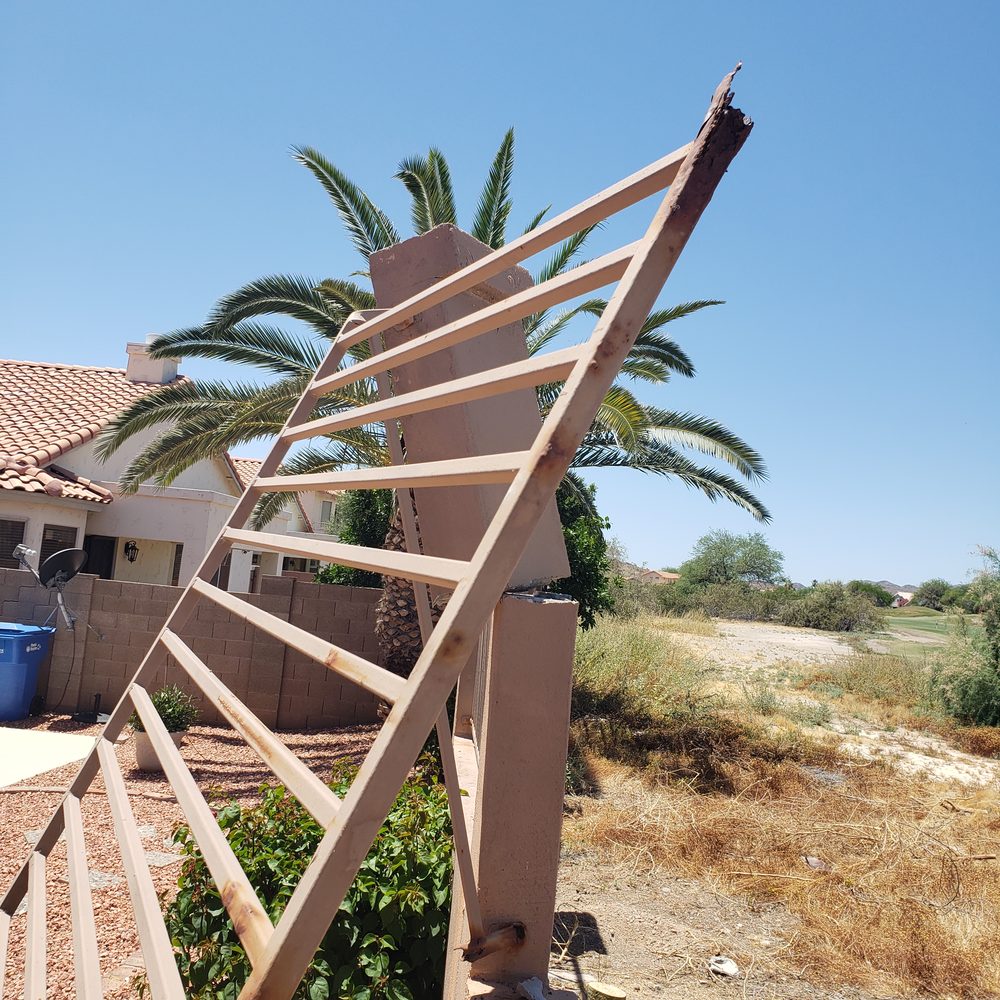
Monsoon wind doesn't need a direct hit to cause real damage — sustained gusts and sudden pressure changes are often enough on their own.
Every July and August, our phones start ringing the morning after a big monsoon cell moves through the Valley, and the calls follow a pattern: a gate that won't close right, a fence panel leaning at an angle it wasn't at yesterday, or worse, a swing gate torn clean off its hinges. Arizona's monsoon season runs officially from June 15 through September 30, with the most intense activity typically landing between mid-July and mid-August. What makes monsoon storms uniquely hard on gates isn't usually the rain — it's the wind, and what the wind carries with it.
Why Monsoon Wind Is a Different Kind of Threat Than Regular Wind
A steady 30 mph wind is something most gates and fences are built to handle without issue. A monsoon microburst is a completely different animal. Microbursts form when a column of cold, dense air inside a thunderstorm collapses and slams into the ground, then spreads outward in every direction as a wall of damaging wind. According to the National Weather Service Phoenix office's storm event archive, these events regularly produce localized wind gusts in the 60–80 mph range, and in the most extreme documented cases, estimated speeds have reached 70–80 mph with damage consistent with an EF1 tornado. A July 2024 microburst event in north Phoenix, documented in detail by NWS Phoenix, toppled large trees that brought down a brick fence, flipped semi trucks on their sides, and collapsed a warehouse roof — all from a storm cell that lasted well under an hour.
The key difference from ordinary wind is that microburst gusts arrive suddenly, from an unpredictable direction, and often catch outdoor structures — including gates in mid-motion — completely off guard. A gate that's perfectly capable of standing up to sustained desert wind can still be damaged by a sudden 70 mph gust it was never braced for.
How Monsoon Wind Damages Automatic Gates

Structural gate repairs spike every year in the weeks following the Valley's most intense monsoon activity.
Automatic gates are particularly vulnerable during a storm because they're often mid-cycle — opening or closing — when a gust hits. A few specific failure patterns we see every monsoon season:
- Motor strain from wind resistance. If a gust hits a slide or swing gate while the operator is actively driving it, the motor has to fight both the gate's normal load and the wind pressure at the same time. This is exactly the kind of load spike that damages gears, straps chains, and shortens motor life — the same components covered in our guide to automatic gate noises and what they mean.
- Swing gate arms bent or torn from their mounts. A swing gate caught broadside by a strong gust puts enormous leverage on the operator arm and its mounting bracket — often enough to bend the arm or pull the mounting hardware loose from the post.
- Electrical and control board damage. Power surges from nearby lightning strikes, even ones that don't hit the property directly, can damage a gate operator's control board. Sudden power loss mid-cycle can also leave a gate stopped in an unsafe position.
- Debris jamming the track or gate path. Palm fronds, branches, and wind-blown yard debris commonly end up in slide gate tracks after a storm, which can grind against the wheels or physically block the gate from completing its cycle.
How Monsoon Wind Damages Manually Operated Gates

Manual gates have no motor resistance to work against wind load, which makes them vulnerable in a different way than automatic gates.
It's a common assumption that a manual gate — one without a motor or operator — is inherently safer in a storm because there's less to break. In some ways that's true, but manual gates fail differently, not less often:
- No resistance against a broadside gust. An automatic gate operator provides some resistance against wind because the motor is actively holding position. A manual gate has nothing holding it in place except its latch and hinges, so a strong gust catching it open or partially open can swing it hard enough to bend hinges, crack a latch, or in severe cases tear the gate off entirely.
- Wood gates absorb sudden moisture after months of heat. A wood pedestrian or driveway gate that's spent months drying and contracting in 115°F heat can absorb monsoon rain quickly, causing the wood to swell unevenly. This is a common cause of a gate that suddenly drags, binds, or won't latch correctly after the season's first big storm.
- Latch and post damage from repeated slamming. A gate that isn't securely latched before a storm can slam repeatedly in gusting wind, which loosens hinge screws, cracks wood posts, and stresses welds on iron gates over the course of a single storm.
Fence Damage: Trees, Debris, and Saturated Ground

View fences and iron fencing generally hold up well structurally, but posts set in saturated soil can shift after heavy monsoon rainfall.
Fences see three distinct kinds of monsoon damage. If your fence took storm damage this season, our view fence repair and installation team handles exactly this kind of post-storm assessment and repair:
- Direct impact from falling trees and large branches. This is the most dramatic and most common cause of a fence section going from standing to flattened in a single storm — and it's almost entirely preventable by trimming dead or overextended branches before monsoon season starts.
- Wind-blown yard debris. Patio furniture, trash cans, and landscaping material become projectiles in a strong gust, and they routinely dent, bend, or crack fence panels and iron pickets.
- Post movement in saturated soil. Arizona's caliche and clay-heavy soil sheds water rather than absorbing it evenly, and a fence post that's been solid for years can shift slightly after several inches of rain saturate the ground around its footing — showing up as a lean that wasn't there before the storm.
Before the Storm: What Actually Reduces Monsoon Damage

Structural welding repairs on bent gate hardware are common in the days following a major monsoon event.
A few preventative steps make a real difference heading into monsoon season — several of these echo the seasonal guidance from the Arizona Department of Emergency and Military Affairs, which recommends trimming dead branches and securing loose yard items before monsoon season begins:
- Trim trees and remove dead branches near any gate, fence line, or garage door before the season starts — this is the single biggest preventable cause of monsoon damage we see.
- Secure loose yard items — furniture, planters, trash cans — before a storm watch, since these become the projectiles that dent fences and jam gate tracks.
- Make sure automatic gates are fully latched or in a secure resting position before a storm rather than mid-cycle, when possible.
- Check that your gate operator has a working battery backup so a power outage mid-storm doesn't leave the gate stuck in an unsafe position.
- Don't force a gate that's binding after a storm. Forcing a swollen wood gate or a gate with debris in the track can cause more damage than the storm itself. Clear visible debris, and call for an inspection if it's still not moving freely.
Monsoon Gate Damage FAQ
Can wind alone damage an automatic gate, even without a tree falling on it?
Yes. Motor strain from wind resistance during a cycle, bent swing gate arms from broadside gusts, and control board damage from power surges are all common wind-only damage patterns we see every monsoon season without any debris involved.
Is a manual gate safer than an automatic gate during a storm?
Not necessarily safer, just differently vulnerable. A manual gate has no motor resistance holding it in place against wind, so a strong gust can bend hinges or damage a latch just as easily as wind can strain an automatic operator.
Why does my gate suddenly bind or drag after the first big monsoon storm?
This is usually wood swelling from absorbing moisture after months of dry heat, or debris that's worked its way into a track or hinge. Don't force it — clear visible debris and call for an inspection if it's still not moving freely.
Should I turn off my automatic gate before a storm?
If a severe thunderstorm watch or warning is active, letting the gate rest in a closed or fully open position rather than leaving it to cycle is a reasonable precaution, since a gate caught mid-cycle by a sudden gust is more vulnerable than one already at rest.
Do you offer emergency gate repair after monsoon storms?
Free service call with repair. Call Charlie at (480) 548-0807 — we see a predictable spike in storm damage calls every monsoon season and prioritize same-day response where possible.
Storm Damage to Your Gate or Fence? We Can Help
Free service call with repair. Call Charlie at (480) 548-0807 — we serve Scottsdale, Phoenix, Paradise Valley, Cave Creek, Carefree, Fountain Hills, Ahwatukee, Tempe, Arcadia, and Anthem.
Frank Vargas — Owner, Security Door Gate & Fence
4th-generation Phoenix native and AFA Certified Gate Automation Designer with 35+ years servicing garage doors and gates across the greater Phoenix area. AZ ROC #325648, #325650, #314281.
Related service pages
- Automatic Gate Repair | Valley-Wide
- Scottsdale Automatic Gate Repair | Same-Day Service
- Phoenix Automatic Gate Repair | Same-Day Service
- Paradise Valley Automatic Gate Repair | Premium Service
- View Fence Repair & Installation
- Scottsdale View Fence Repair
- Perimeter Fencing
Related blog posts
- Automatic Gate Noises in Arizona: What Every Sound Means (and Common Summer Repairs)
- Why Arizona Summer is the Worst Season for Your Automatic Gate
- How Much Does a New Garage Door Cost in Arizona?


 (480) 548-0807