


Automatic Gate Repair in Arizona Summer: Heat, Rats, Snakes & Monsoon Damage | Security Door Gate & Fence
Arizona Homeowner Tips · Automatic Gate Repair
Why Arizona Summer is the Worst Season for Your Automatic Gate — Heat, Wildlife & Monsoon Damage
By Frank Vargas · Security Door Gate & Fence · Scottsdale, AZ · Updated June 2026
An automatic gate that worked perfectly in April can stop dead in its tracks by July — and not always for the reasons you’d expect. Yes, extreme heat plays a role. So does monsoon season. But some of the most unusual gate failures we see every summer across Scottsdale, Cave Creek, Carefree, Paradise Valley, Fountain Hills, and Phoenix have nothing to do with mechanical wear or electrical failure in the traditional sense.
They have everything to do with wildlife.
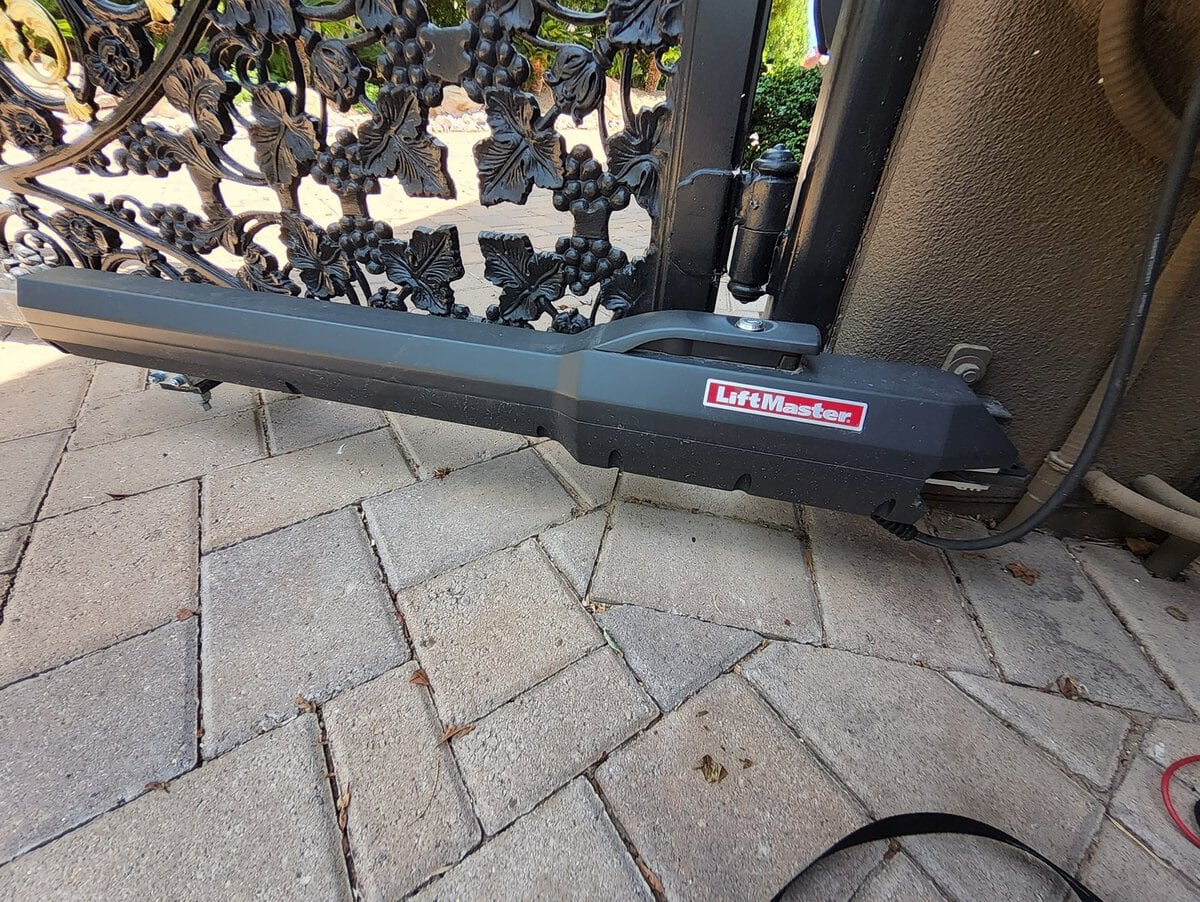
After 35 years of servicing automatic gates across the greater Phoenix area, I’ve pulled rattlesnakes out of LiftMaster operator housings, found pack rat nests completely filling the wiring compartment of slide gate motors, and diagnosed gate failures that turned out to be nothing more than a chewed-through low-voltage wire that cost a rat thirty seconds to destroy and us an hour to diagnose and repair.
This article covers everything that Arizona summer does to automatic gates — the heat-related failures, the wildlife-related failures, the monsoon damage, and what you can do to prevent all of it before you’re making an emergency call on a 112-degree Saturday afternoon.

What Arizona Summer Heat Does to Gate Operators
Gate operators — the motor-driven units that actually move your gate — are rated by manufacturers for specific operating temperature ranges. Most commercial-grade operators are rated to 140°F ambient temperature. That sounds like plenty of headroom until you consider that a black powder-coated operator housing sitting in direct western sun in Cave Creek or Carefree on an August afternoon can reach internal temperatures of 160°F or higher.
Circuit board failures
The circuit board inside your gate operator is the most heat-sensitive component in the entire system. Capacitors — small cylindrical components that store charge — begin to fail at sustained temperatures above 140°F. Once a capacitor fails, the board may work intermittently (operating fine in the morning cool, failing in afternoon heat) before failing completely. Intermittent failure is the most frustrating to diagnose because the gate often works normally when our technician arrives — only to fail again at 3pm when nobody is watching.
In our experience, circuit board failures spike every year in late July and August across the Valley, particularly in Cave Creek, Carefree, and north Scottsdale where operators are often installed on west-facing walls or gate posts with no shade coverage.
Motor winding burnout
Gate operator motors are designed to run in cycles — open, pause, close — not continuously. In normal conditions, the motor runs briefly, stops, and has time to cool between cycles. But when an operator is already running hot from ambient temperature, and the gate is used frequently during the day (think: a property with multiple family members coming and going, or a vacation rental with high turnover), the motor never fully cools between cycles. This causes the copper windings inside the motor to overheat, and once the insulation on those windings burns through, the motor is finished.
Hydraulic oil thinning in HySecurity and FAAC operators
High-end commercial operators from HySecurity, FAAC, and similar manufacturers use hydraulic fluid to drive the gate. In Arizona summer heat, standard hydraulic fluid thins significantly, reducing system pressure and causing sluggish or inconsistent gate movement. If you have a hydraulic operator and notice your gate moving more slowly in summer heat than in cooler weather, low viscosity hydraulic fluid is the likely culprit. The fix is a fluid viscosity grade appropriate for high-temperature operation — something we specify on every hydraulic operator install in this climate.
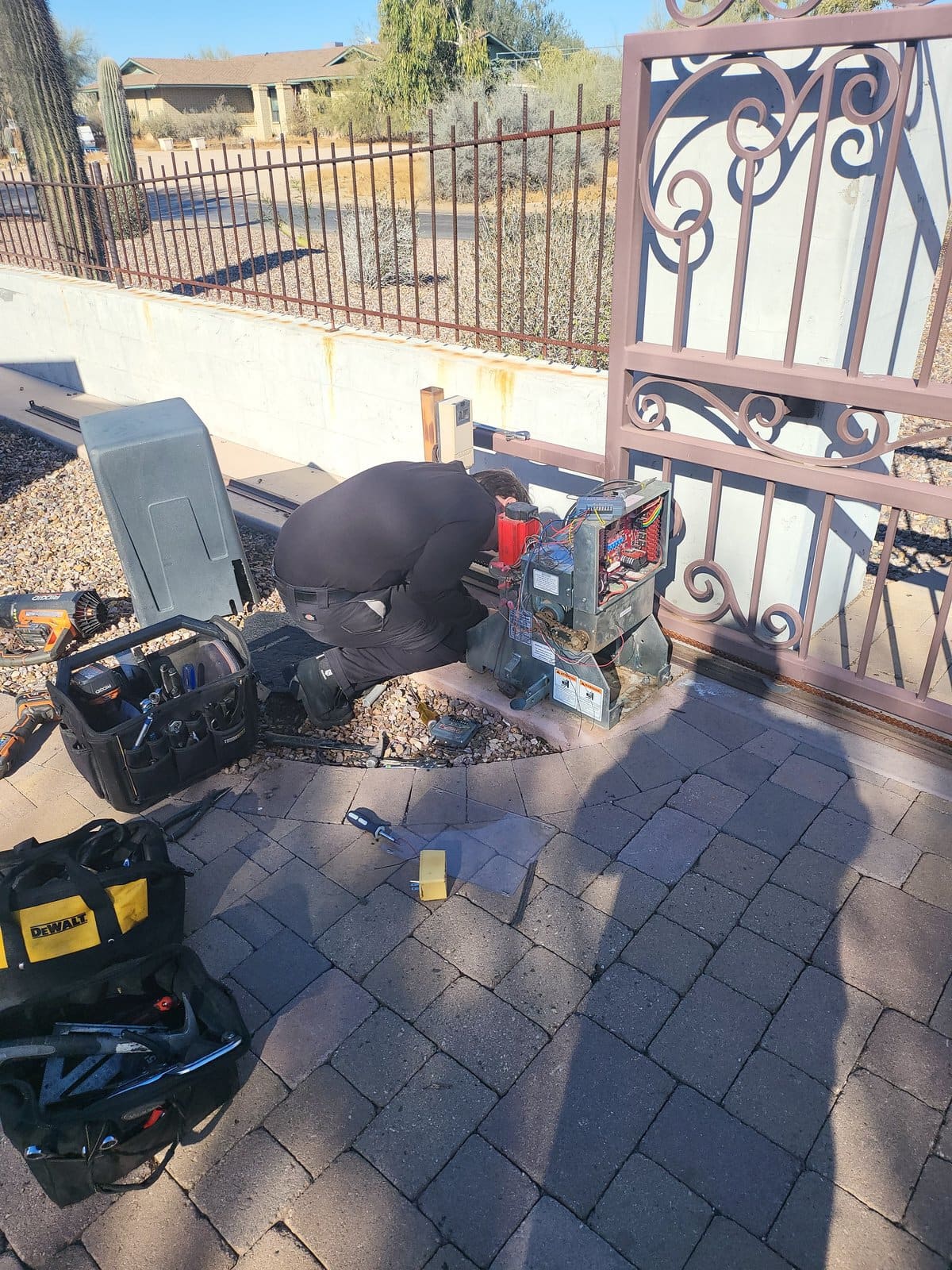
Wildlife in Gate Operators: The Problem Nobody Talks About
This is the section that surprises most homeowners — particularly those who’ve recently moved to the Valley from out of state. Arizona’s desert wildlife is remarkably resourceful, and gate operator housings offer exactly what desert animals are looking for: a dark, enclosed, climate-moderated space that’s elevated off the ground and largely undisturbed.
Pack rats and roof rats: the #1 gate wiring destroyer in Arizona
Pack rats (also called wood rats) and roof rats are endemic across the greater Phoenix area, and they’re especially prevalent in the desert communities north and east of the city — Cave Creek, Carefree, Fountain Hills, and the hillside properties of north Scottsdale and Paradise Valley. These animals are compulsive chewers. They chew wiring not because they’re hungry but because their teeth grow continuously and they need to keep them worn down.
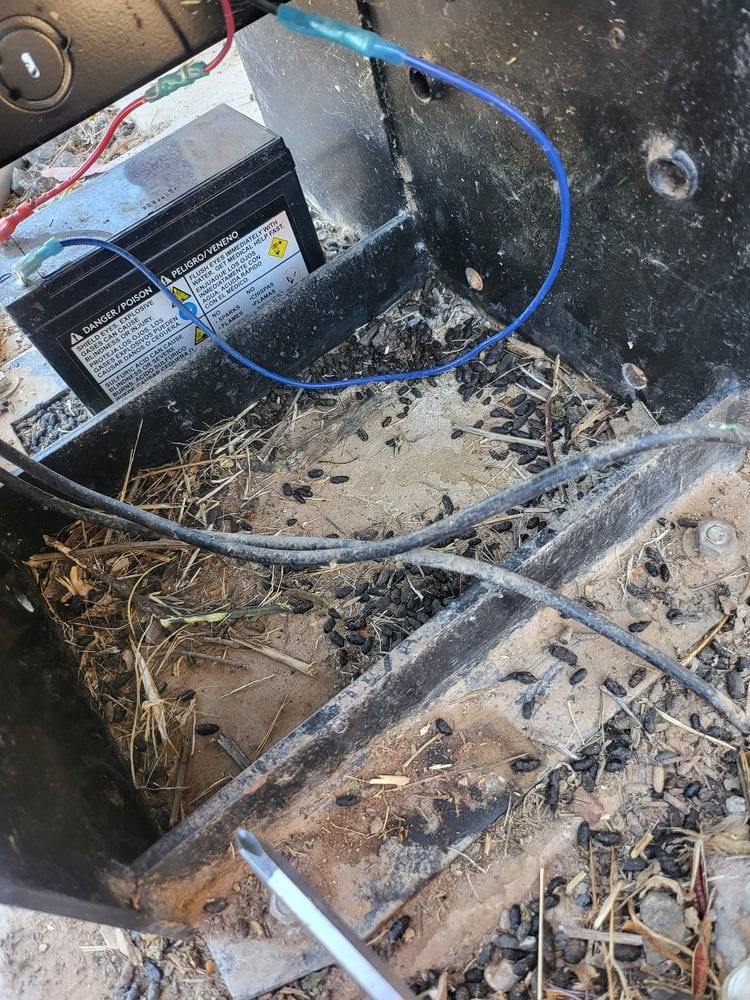
A single pack rat can destroy the entire wiring harness inside a gate operator in one night. We’ve opened operator housings and found the entire interior — control board, wiring, sensors, battery backup — filled with a nest made of cholla cactus, shredded insulation, and cactus spines, with every wire in the unit chewed through at multiple points. The rat didn’t need to eat the wires. It just needed something to chew, and your gate operator’s wiring loom was conveniently available.
Signs of rodent activity in your gate operator
Gate operates intermittently with no pattern — works one day, not the next. Gate throws error codes that don’t correspond to any obvious mechanical problem. You hear scratching or rustling from the operator housing. You notice cholla spines, dried grass, or shredded material around the base of the gate post. Any of these warrants opening the operator housing for inspection — do not keep attempting to operate a gate that may have active nesting inside.
Rattlesnakes: less common, but serious
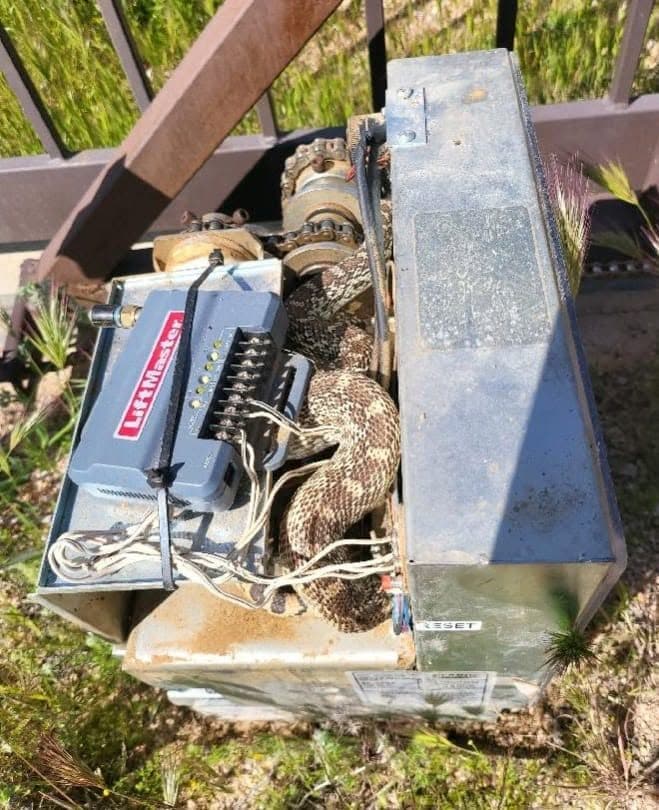
Rattlesnake intrusion into gate operators is less common than rodent nesting but far more serious when it happens. Rattlesnakes are attracted to the residual warmth of an operator housing at night — particularly after a hot day when the housing has absorbed significant heat. They enter through the same gaps that rodents use: cable entry points, ventilation slots, or gaps between the housing panels.
This is most prevalent in Cave Creek, Carefree, and the desert-edge properties of north Scottsdale and Fountain Hills where rattlesnake populations are higher. If you open your operator housing and find a rattlesnake inside, do not attempt to remove it yourself. Call a licensed wildlife relocation service. We do not remove snakes — that’s not what we’re trained for — but we do encounter them regularly enough that we keep a protocol: if a housing appears to be inhabited, we do not reach inside until we can visually confirm it’s clear.
After any snake intrusion, the operator housing should be inspected thoroughly for damage to wiring insulation from the snake’s movement through the unit, and all entry points should be sealed.
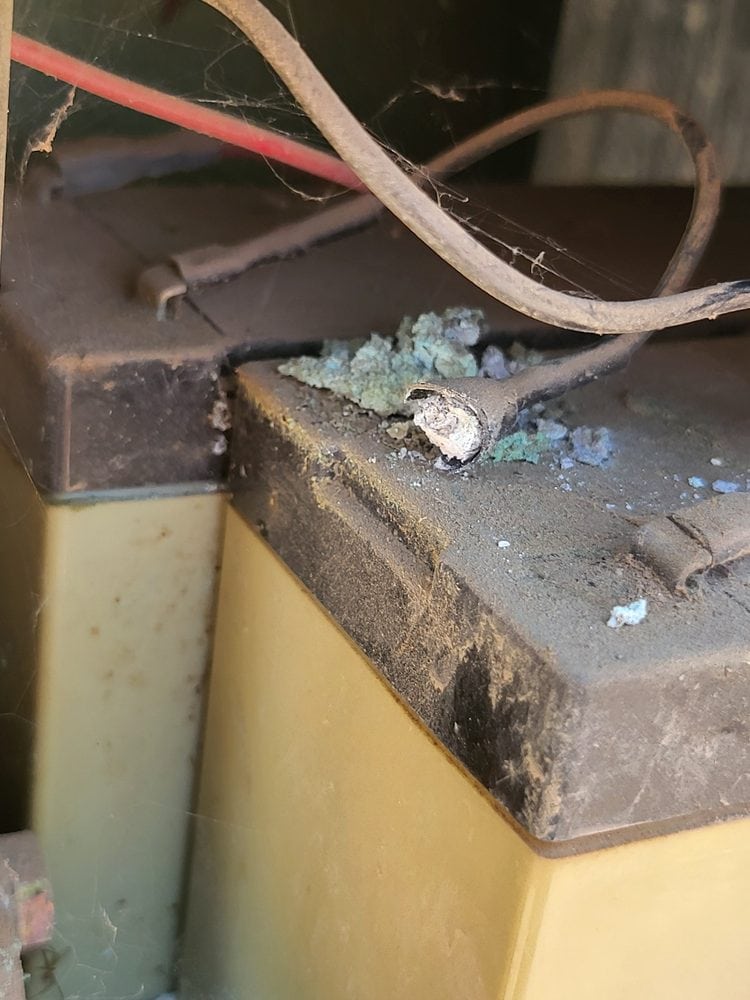
Wasps and paper wasps: a late summer specialty
Paper wasps and mud daubers build nests inside operator housings throughout summer, typically starting in June and reaching full size by August. A wasp nest inside an operator housing isn’t just a nuisance — the nest material can block ventilation slots that the operator relies on for heat dissipation, and wasps can trigger the operator’s obstruction sensors if they fly through the gate’s safety beam. If your gate reverses for no apparent reason in late summer, check the photo-eye sensors for wasp activity before assuming an electrical fault.
Monsoon Season Gate Damage: June Through September
Arizona’s monsoon season runs from mid-June through late September, bringing intense but brief thunderstorms with lightning, high winds, blowing dust, and heavy rainfall. Each of these elements creates its own category of gate damage.
Lightning strikes and power surges
A direct lightning strike within a quarter mile of your property can send a voltage surge through your gate operator’s power supply that instantly destroys the circuit board — even if the gate itself is not struck directly. The surge travels through the power line feeding the operator, through the transformer, and directly into the control board. We replace more gate operator circuit boards in July, August, and September than in the other nine months of the year combined, and most of those failures trace to monsoon lightning activity rather than age or heat.
The solution is a proper surge protector installed on the operator’s power supply — not a standard power strip surge protector, but a hardwired whole-circuit surge suppressor designed for low-voltage gate operator systems. This is something we install on every new gate system and highly recommend as a retrofit on existing systems.
Wind damage and gate misalignment
Monsoon storms in Cave Creek and Carefree routinely produce wind gusts exceeding 60 mph — occasionally 80 mph or higher during the most severe haboobs. A slide gate that’s properly adjusted and running smoothly in calm conditions can be knocked off its track or have its wheel assemblies damaged by a gate that gets caught by wind during a storm. Swing gates are particularly vulnerable — a 12-foot swing gate panel acts like a sail in a 70 mph wind, putting enormous stress on the hinges, the operator arm connection, and the gate post anchor bolts.
After any severe monsoon storm, it’s worth doing a visual inspection of your gate: check that it opens and closes fully without binding, that the operator arm connection is tight, and that the gate sits squarely in its opening when closed.
Dust intrusion into photo-eye sensors
Haboob dust storms — the towering walls of blowing sand that sweep through the Valley several times each monsoon season — coat everything outdoors with a fine layer of dust. Your gate’s photo-eye sensors, which create the safety beam that prevents the gate from closing on a vehicle or person, are particularly vulnerable. A thick coating of dust on the photo-eye lens will cause the beam to read as broken even when nothing is in the gate’s path, causing the gate to refuse to close.
After every significant dust storm, wiping both photo-eye sensor lenses clean with a soft cloth is a 30-second maintenance task that prevents unnecessary service calls.
After every monsoon storm — quick inspection checklist
Gate opens and closes fully without binding or hesitation. Operator arm connection is tight. Gate sits squarely in opening when closed. Photo-eye sensor lenses are clean. No visible debris caught in the gate track or hinge areas. Keypad and remote still function normally. If anything seems off, call us before the next storm — monsoon damage compounds quickly.
Summer Automatic Gate Maintenance Checklist
Pre-Summer & Monsoon Gate Maintenance Checklist
- Inspect operator housing for rodent nesting, droppings, or chewed wiring
- Seal all cable entry points with weatherproof conduit fittings or steel wool
- Check ventilation slots — clear of wasp nests, debris, or blockage
- Test gate balance — disconnect operator and move gate manually, should move freely
- Lubricate slide gate wheels and track (lithium grease, not WD-40)
- Lubricate swing gate hinges and operator arm pivot points
- Check all hinge hardware and post anchor bolts for loosening
- Inspect operator arm connection — both ends tight, no play
- Test safety reversal — place object in gate path and attempt to close
- Clean both photo-eye sensor lenses
- Check photo-eye alignment — signal light on receiver should be solid, not blinking
- Test all remotes, keypads, and telephone entry functions
- Test battery backup — disconnect power and confirm gate still operates
- Inspect surge protector on power supply — replace if status light indicates fault
- Check operator housing cover seals — no gaps, cracks, or missing screws
- Inspect gate track for debris, warping, or damage from previous season
- Check all low-voltage wiring connections at operator and access control panels
City-by-City: What We See Most in Each Community
Cave Creek & Carefree
These two communities have the highest rate of wildlife-related gate operator damage we see across the entire Valley. Pack rat nesting is nearly universal in properties with established desert landscaping — if you have cholla cactus anywhere near your gate post, you have pack rats nearby. We strongly recommend annual housing inspection and proactive wire harness protection (spiral wire loom or conduit) on every gate operator in Cave Creek and Carefree. Rattlesnake intrusion is also significantly more common here than in urban Scottsdale or Phoenix. Cave Creek automatic gate repair →
Fountain Hills
Fountain Hills properties on the McDowell Mountain perimeter see high wind exposure during monsoon season — wind-driven gate damage is more common here than in sheltered valley communities. Slide gates in particular should have their wheel assemblies inspected annually for stress fractures from wind loading. Fountain Hills automatic gate repair →
Paradise Valley
Paradise Valley gate systems tend to be high-end — LiftMaster RSW12U, HySecurity HydraSwing, FAAC hydraulic operators on custom iron gates. These systems are more capable but also more expensive to repair when heat or wildlife damage hits. Annual preventative inspection is especially worthwhile here given the cost of components. Paradise Valley automatic gate repair →
Scottsdale
North Scottsdale (85255, 85262, 85266) sees significant pack rat pressure similar to Cave Creek. South and central Scottsdale see more lightning and power surge damage due to the urban heat island effect intensifying monsoon storm activity. Both warrant pre-summer inspection. Scottsdale automatic gate repair →
Phoenix
Phoenix’s commercial gate systems — apartment complex slide gates, storage facility barrier arms, HOA community gates — see the highest volume of heat-related motor burnout simply because of usage frequency. A residential gate might cycle 6–10 times per day. An apartment complex gate can cycle 200–400 times per day, and high-cycle operators that aren’t maintained going into summer don’t always make it out. Phoenix automatic gate repair →
How to Protect Your Gate Operator from Wildlife
The most effective wildlife protection measures are also the simplest. Here’s what we recommend and install on gate systems in desert communities:
Seal every cable entry point
The single biggest point of entry for rodents and snakes is the cable penetration holes in the operator housing — the openings where power cable, low-voltage wiring, and loop detector leads enter the unit. These openings are often left with significant gaps around the conduit or cable. Fill them with steel wool (rodents won’t chew through it) and seal over with weatherproof caulk, or use properly sized conduit fittings that leave no gap.
Protect wiring with spiral loom or conduit
Any exposed wiring running between the operator and the gate post, access control panel, or photo-eye sensors should be run inside metal conduit or at minimum heavy-duty spiral wire loom. Pack rats can chew through standard plastic wiring harness insulation in seconds. They cannot chew through metal conduit. This is a one-time retrofit that prevents recurring wiring failures indefinitely.
Install rodent deterrents near gate posts
Ultrasonic rodent deterrents have mixed effectiveness, but physical deterrents — clearing cholla and other pack rat habitat materials from within 10 feet of the gate post, removing any debris piles or wood stacks near the operator — meaningfully reduce rodent pressure. Pack rats build their middens (nest piles) close to food and shelter sources. Removing the habitat reduces the likelihood of nesting in your operator.
Add a surge protector to the operator power supply
A hardwired surge suppressor on your gate operator’s power circuit is inexpensive insurance against monsoon lightning damage. We install these on every new gate system as standard practice. If your existing system doesn’t have one, it’s a simple add-on that can save you the cost of a circuit board replacement after the first bad monsoon storm.
Cave CreekCarefreeScottsdalePhoenixParadise ValleyFountain HillsAhwatukee
Gate Not Working? Call Before It Gets Worse
Free service call with repair. Call Charlie at (480) 548-0807 — we serve Scottsdale, Phoenix, Paradise Valley, Cave Creek, Carefree, Fountain Hills, and the surrounding Valley. Same-day response for gates stuck open.Call (480) 548-0807
Frequently Asked Questions: Summer Gate Repair in Arizona
My gate worked fine yesterday and won’t open today — what happened?
The most likely causes in summer are: circuit board failure from heat or lightning surge, a tripped thermal overload breaker (the operator overheated and shut itself off — wait 30 minutes and try again), a dead battery backup that prevented operation after a power interruption, or — in Cave Creek, Carefree, and north Scottsdale — rodent damage to wiring that occurred overnight. Check whether the operator shows any indicator lights or error codes, and call us if you can’t identify the issue.
Is there a service call fee for gate repair?
Free service call with repair. Call Charlie at (480) 548-0807 to schedule.
Can I open a gate operator housing myself to check for wildlife?
Yes — most operator housings have a simple latch or Phillips screws. Before opening, knock firmly on the housing several times and wait 30 seconds. This gives any wildlife inside time to move. Open slowly and stand to the side rather than directly in front. If you see a rattlesnake, close the housing and call a licensed wildlife removal service — do not attempt to remove it yourself. For rodent nests without active animals, the nest material can be removed and the housing cleaned, but all wiring should be inspected for damage before restoring power.
My gate closes partway and then reverses — is this a wildlife issue?
Not necessarily. Partial close followed by reversal is most commonly caused by: an obstruction in the gate’s path (check the track), dirty or misaligned photo-eye sensors (clean both lenses), a gate that’s come off its track or is binding on debris, or an operator force setting that’s too sensitive. Wildlife becomes a more likely explanation when this behavior appears suddenly with no prior warning, particularly overnight — a fresh nest blocking the safety beam or a chewed sensor wire are common culprits in desert communities.
How much does gate operator repair cost in Arizona?
It depends entirely on what failed. A chewed wire harness can be as straightforward as a splice repair. A full circuit board replacement runs $200–$500 depending on operator brand and board availability. Motor replacement is typically $300–$600. We diagnose on-site and give you a written estimate before doing any work. Call Charlie at (480) 548-0807 for scheduling.
FV
Frank Vargas — Owner, Security Door Gate & Fence
4th-generation Phoenix native and AFA Certified Gate Automation Designer with 35+ years servicing automatic gates across the greater Phoenix area. AZ ROC #325648, #325650, #314281. Frank and Charlie have been keeping Valley properties secure since 2016.
Related service pages
- Scottsdale Automatic Gate Repair | Same-Day Service
- Phoenix Automatic Gate Repair | Same-Day Service
- Paradise Valley Automatic Gate Repair | Premium Service
- Cave Creek Automatic Gate Repair | Same-Day Service
- Fountain Hills Automatic Gate Repair | Same-Day Service
- Summer Garage Door Maintenance in Arizona | Preventative Care Guide


 (480) 548-0807