


By Frank Vargas · Security Door Gate & Fence · Scottsdale, AZ · July 2026
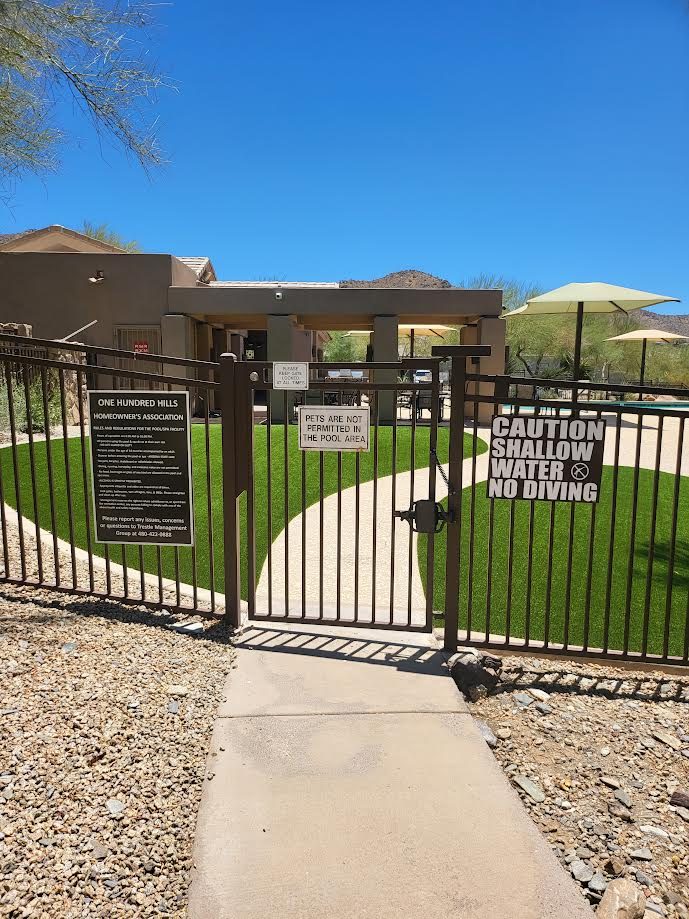
Arizona's pool barrier law is one of the most detailed in the country — and one of the most commonly misunderstood by homeowners installing a new pool fence.
We install pool fencing across the Valley every week, and almost every job starts with a homeowner asking some version of "how high does this actually need to be?" or "does the gate really need to swing that way?" Arizona's pool enclosure law is genuinely specific — down to the exact size of gap a fence is allowed to have — and getting it wrong isn't just a safety issue, it can hold up your final inspection or leave you exposed to fines. Here's what the law actually requires.
A quick note before we get into it: this is general information based on Arizona statute and municipal code — it isn't legal advice. Cities can and do add requirements stricter than the state minimum, so always confirm with your local building department before finalizing a design.
The State Baseline: ARS §36-1681
Arizona Revised Statutes §36-1681 applies to any pool or contained body of water that's deeper than 18 inches at any point and wider than 8 feet — which covers essentially every residential swimming pool in the Valley. The core requirements:
- Minimum height: 5 feet (60 inches), measured on the exterior side of the wall, fence, or barrier.
- The 4-inch sphere test: no opening in the barrier can allow a 4-inch diameter sphere to pass through — this is the actual legal test inspectors use, not a rough guideline.
- Mesh and spacing limits: horizontal fence components must be spaced no less than 45 inches apart vertically, or if placed on the pool side of the barrier, openings can't exceed 1.75 inches — this is the rule that governs chain-link and wire mesh pool fencing specifically.
- No climbable surface: the barrier can't have handholds or footholds on the exterior side that would let someone climb it.
- Gates must open outward, away from the pool, and be self-closing and self-latching.
When the House Itself Is Part of the Barrier

Self-latching gate hardware is one of the most commonly failed items during a pool barrier inspection.
A lot of Valley homes have a pool that's directly accessible from the house, without a full fence separating them. Arizona law accounts for this, but it requires one of the following in place of a full standalone enclosure:
- A minimum 4-foot wall, fence, or barrier between the pool and the residence, meeting the same opening and spacing rules as the main barrier.
- A motorized safety pool cover that requires a key switch to operate and meets ASTM safety cover standards — a standard retractable cover doesn't qualify.
- Self-latching devices on all ground-level doors with direct pool access, plus matching latching requirements on windows that access the pool area.
- For above-ground pools specifically: non-climbable exterior sides at least 4 feet high, with any ladder or steps removable or secured at least 54 inches above ground when the pool isn't in use.
Where Local Code Is Stricter Than State Law

Several Valley cities add requirements beyond the state's 5-foot minimum — always confirm with your specific city before finalizing a design.
ARS §36-1681 sets the statewide floor, but cities are free to require more, and several do:
- Phoenix has adopted the International Swimming Pool and Spa Code with city-specific amendments under Phoenix City Code §39-7. Phoenix explicitly requires the gate latch to sit at least 54 inches above the ground (state law doesn't specify an exact latch height in the main barrier requirement, only for above-ground pool ladders). Phoenix also mandates an interior barrier between the house and pool whenever the residence is used as part of the enclosure — one of three specific options: a self-closing/self-latching interior fence meeting the same specs as the main barrier, a compliant motorized safety cover, or self-latching doors and windows at the required heights. This interior-barrier requirement applies specifically to homes with children under 6 on the property.
- Scottsdale requires a 60-inch perimeter fence and, for short-term rental properties specifically, a secondary barrier around the pool itself — either a separate pool fence or an alarm system on doors and windows leading to the pool area. Gate latches must also sit at least 54 inches high. This falls under Scottsdale Revised Code §18-175(g) and Chapter 31, Article XIII, which adopts the International Swimming Pool and Spa Code.
- Maricopa County requires public and commercial pools — not private residential ones — to be enclosed by a barrier at least 6 feet high, with a 3-foot clear zone outside the barrier to prevent using nearby objects to climb over. If you're managing an HOA community pool or a multi-family property pool anywhere in the county, the county's stricter public-pool standard applies rather than the residential state minimum.
- Chandler requires a 6-foot fence, a full foot taller than the state minimum, for residential pools.
If you're installing pool fencing anywhere in the Valley, the state law is the floor, not the ceiling — Phoenix, Scottsdale, Maricopa County, and Chandler each layer on additional specifics, and getting the latch height or interior barrier requirement wrong is one of the most common reasons a pool fails its final inspection. Always verify your specific city's requirements before finalizing your design.
Exemptions Under State Law
A few situations fall outside the standard requirements:
- Residences where every occupant is 6 years of age or older may be exempt from certain provisions.
- Agricultural stock ponds and irrigation canals are excluded from residential pool enclosure rules entirely.
These exemptions are narrow, and cities can still impose their own requirements regardless of the state exemption — don't assume an exemption applies without checking with your local building department.
What Happens If Your Pool Fence Isn't Compliant

Bringing an older pool fence up to current code is one of the most common jobs we handle across the Valley.
If a property is cited for a non-compliant pool barrier, Arizona law provides a 45-day window to correct the violation and complete a pool safety course, which avoids the fine if done within that window. After the 45-day period, continued non-compliance becomes a Class 1 misdemeanor — the same charge classification as a first-offense DUI in Arizona — with meaningful fines attached. This is one area where "I'll get to it eventually" carries real legal weight, not just a warning letter.
Permits and Inspection
Pool fence installation typically requires a permit from your local building department, and a final inspection is required before the barrier is considered compliant. In most Valley cities, a homeowner can pull their own permit for a straightforward barrier installation, though a licensed contractor makes sense for anything beyond a simple fence line — particularly gate hardware, since self-latching mechanisms are one of the most commonly failed items at final inspection.
Arizona Pool Fence Law FAQ
How high does a pool fence need to be in Arizona?
At minimum, 5 feet (60 inches) under state law, measured on the exterior side. Phoenix and most Valley cities hold to that same 5-foot minimum but add their own gate and interior-barrier specifics, Scottsdale requires 60 inches with additional secondary barrier rules for short-term rentals, and Chandler requires a full 6 feet.
Does my pool gate really need to swing outward?
Yes. ARS §36-1681 requires pool gates to open outward, away from the pool, and to be self-closing and self-latching. This is a specific legal requirement, not a general best practice.
What's the "4-inch sphere test"?
It's the actual legal test used to evaluate whether a barrier's openings are too large — no gap in the fence or gate can allow a 4-inch diameter sphere to pass through, since that's roughly the threshold for a small child getting through or stuck.
Can I use my house wall as part of the pool barrier?
Yes, if you meet one of the alternative requirements: a 4-foot interior wall between the house and pool, a motorized safety cover with a key switch, self-latching doors and windows with proper hardware, or (for above-ground pools) non-climbable sides with a secured ladder.
What happens if my pool fence fails inspection or gets cited?
You typically get a 45-day window to correct the issue and complete a pool safety course without a fine. After that window, continued non-compliance becomes a Class 1 misdemeanor with real fines attached.
Bring Your Pool Fence Up to Code
Free service call with repair, and free estimates for new pool fence installation. Call Charlie at (480) 548-0807 — we serve Scottsdale, Phoenix, Paradise Valley, Cave Creek, Carefree, Fountain Hills, Ahwatukee, Tempe, Arcadia, and Anthem.
Frank Vargas — Owner, Security Door Gate & Fence
4th-generation Phoenix native and AFA Certified Gate Automation Designer with 35+ years servicing garage doors and gates across the greater Phoenix area. AZ ROC #325648, #325650, #314281.
Related service pages
- Pool Fencing | Scottsdale
- Paradise Valley Gates & Fencing
- View Fence Repair & Installation
- Perimeter Fencing
Related blog posts
- HOA Garage Door & Gate Rules in Arizona: Who's Responsible for Repairs?
- Arizona Monsoon Damage: What Wind and Debris Do to Automatic and Manual Gates


 (480) 548-0807